

Identify PVC OD and ID Fast: 5 OD Measurements to Memorize for Fittings
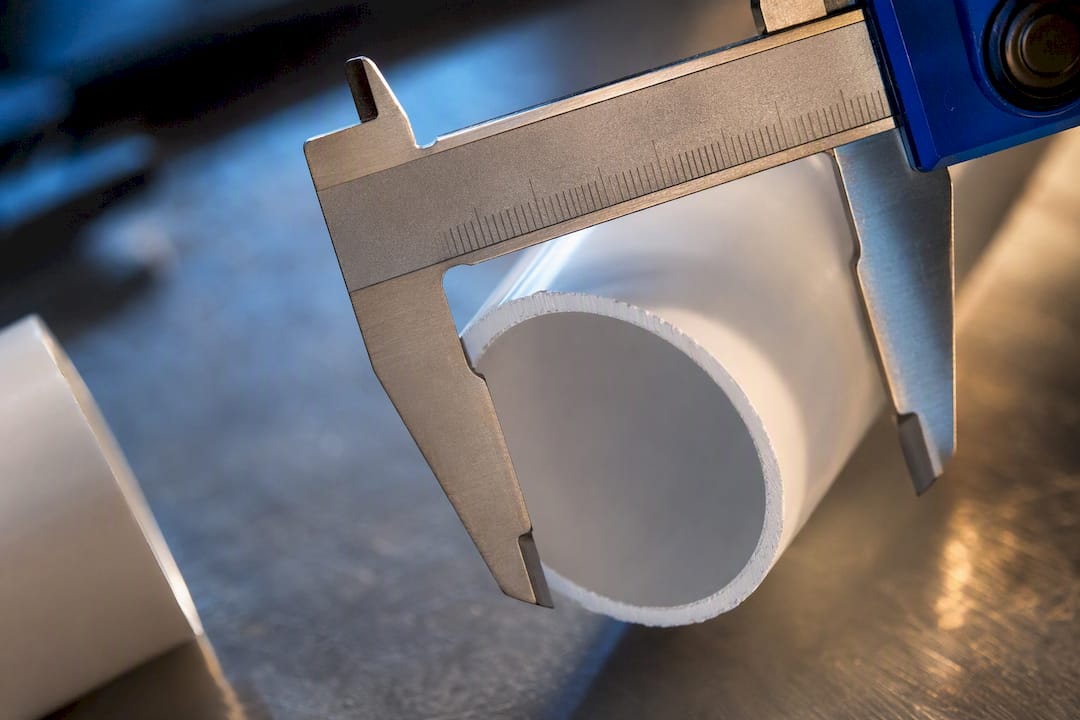
Nominal PVC sizes are labels, not measurements. The outside diameter (OD) is the real, physical number that determines which fittings fit, and it stays fixed for a given nominal size no matter which schedule you buy. The inside diameter (ID) shrinks as wall thickness increases, so a “2 inch” pipe always measures the same on the outside but holds less water on the inside once you move from Schedule 40 to Schedule 80. Check the chart below for exact figures before you cut or order anything.
TL;DR:
Matching PVC fittings to actual outside diameter ensures proper fit, especially since nominal sizes do not reflect real measurements.
Schedule changes affect internal diameter significantly, with Schedule 80 reducing water capacity by roughly 6.5% compared to Schedule 40 at the same nominal size.
Measuring the outside diameter with calipers before ordering prevents costly mistakes when selecting fittings for pressure or furniture-grade applications.
Using the standardized OD series allows PVC pipes to fit compatibility, but mixing different diameter families like CTS or PIP can cause fitting issues.
Relying on manufacturers’ charts and standards like ASTM D1785 helps ensure accuracy when matching pipes and fittings, especially for pressure-critical systems.
Table of Contents
PVC Pipe OD vs ID Quick-Reference Chart
Here’s the fastest way to identify pipe on a job site: measure the outside diameter with calipers, then match it against the nominal size column below. The OD never changes between schedules. The ID does, because it’s whatever is left after you subtract the wall thickness on both sides.
These figures come from published dimension tables including Professional Plastics’s PVC pipe specifications and PlasticRanger’s sizing charts, both built around the same IPS outer-diameter series. One caveat: chart IDs are typically “average” figures, while ASTM tables list minimum wall thickness, so your actual measured ID can run a few thousandths of an inch tighter or looser than what’s printed. Five numbers worth memorizing if you work with PVC often: 3/4" OD is 1.050", 1" OD is 1.315", 2" OD is 2.375", 3" OD is 3.500", and 4" OD is 4.500".
What Do Nominal Size, OD, and ID Actually Mean?
The confusion around PVC pipe od vs id starts with the naming system itself, which was never designed to match a ruler.
Nominal Pipe Size (NPS/IPS): A trade name, not a measurement. A “1 inch” PVC pipe doesn’t measure 1 inch anywhere on it. The label traces back to old iron pipe sizing (IPS), and PVC manufacturers kept the same OD series so plastic pipe could swap into iron-pipe fittings.
Outside Diameter (OD): The actual, physical measurement across the outside of the pipe wall. This number is standardized and fixed per nominal size.
Inside Diameter (ID): The actual open bore through the center, calculated as OD minus twice the wall thickness. This is the number that varies by schedule.
Not every plastic pipe uses the IPS OD series, either. Uni-Bell’s guide to diameter types points out that CTS (copper tube size) pipe is sized to match copper tubing OD, while PIP and CIOD series show up in irrigation and gravity sewer lines with different outer dimensions entirely. Grab the wrong OD family and a fitting that looks right will never seat correctly. ASTM D1785 formalizes the IPS dimensions, tolerances, and markings for Schedule 40, 80, and 120 pipe, which is why the numbers in most charts line up regardless of manufacturer.
How Does Schedule Change Wall Thickness and ID?
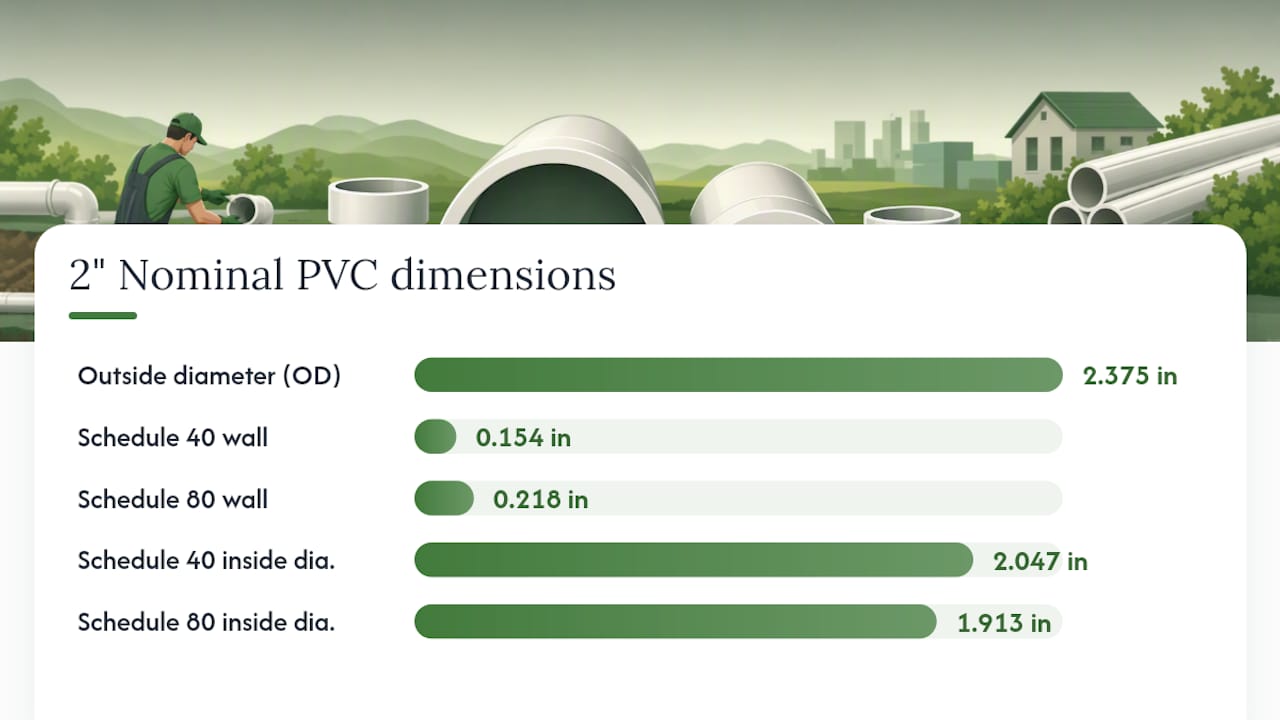
“Schedule” is shorthand for wall thickness. A higher schedule number means a thicker wall, which eats into the open bore without touching the outside measurement at all.
Take 2" nominal pipe as the example, since its OD (2.375") never moves:
Schedule 40 wall thickness runs about 0.154 inches, leaving an ID around 2.047 inches.
Schedule 80 wall thickness jumps to roughly 0.218 inches, dropping the ID to about 1.913 inches.
Both pipes accept the same OD-based fittings because the outside dimension is identical.
Schedule 80 loses about 6.5% of its inside diameter versus Schedule 40 at the same 2" nominal size (Pipe sizing), purely from added wall thickness. Choose Schedule 40 for standard residential drain, waste, and low-pressure water lines where cost matters more than margin. Choose Schedule 80 when you need higher pressure ratings, more impact resistance, or you’re running threaded connections, which cut into wall thickness and need the extra material to stay strong.
How Do You Measure OD and Calculate ID Yourself?
Grab a set of calipers. A tape measure works in a pinch, but it rounds and slips on curved surfaces, which throws off fitting fit more than people expect.
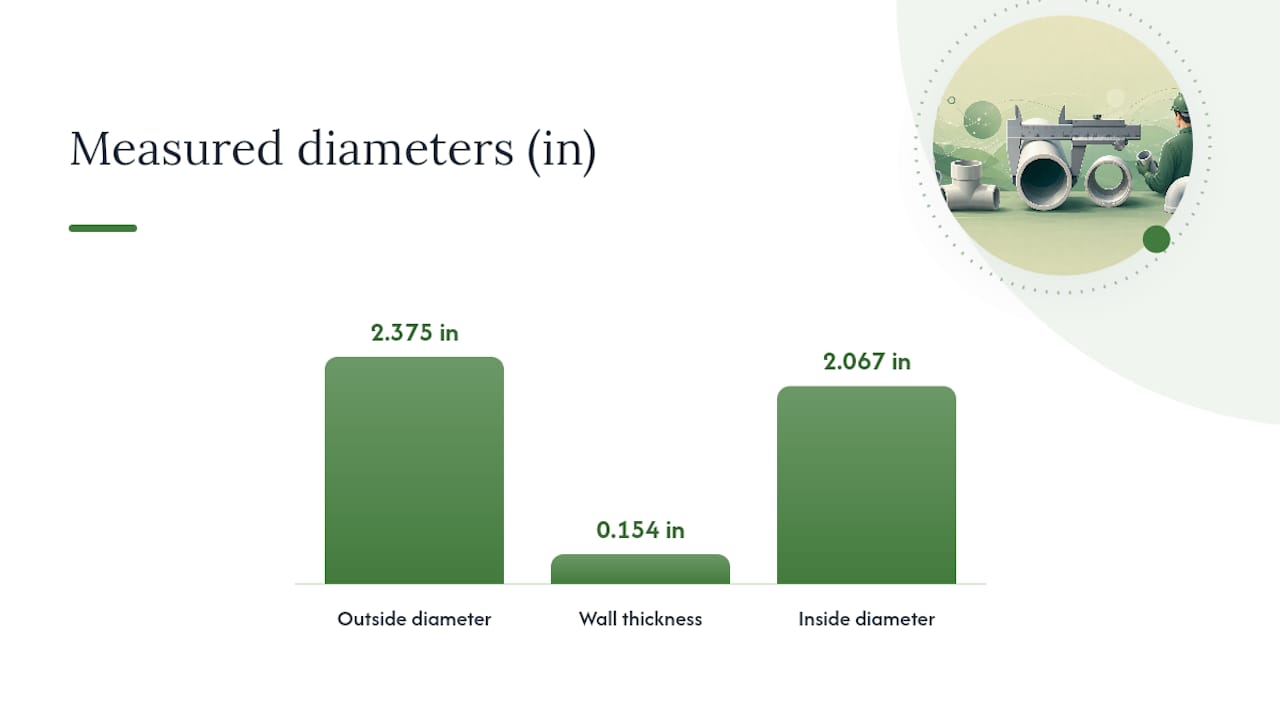
Measure the outside diameter at the pipe’s cut end, in two spots 90 degrees apart, and average them if the pipe is slightly out of round.
Measure the wall thickness at the same cut end.
Calculate ID using OD minus two times the wall thickness. For a pipe measuring 2.375" OD with a 0.154" wall, that’s 2.375 minus 0.308, or 2.067 inches.
Cross-check your OD reading against a standard chart to confirm the nominal size and schedule.
Old pipe with scale buildup, paint, or corrosion will read a slightly larger OD than spec, so scrape a clean spot before measuring anything that’s been in service a while.
Pro Tip: If the pipe is still installed and you can’t get calipers around the wall, measure the OD only, then look up both the Schedule 40 and Schedule 80 ID for that OD. If you know the application (pressure line versus gravity drain), you can usually tell which schedule you’re holding without cutting anything.
How Do You Match Fittings to OD Correctly?
Fittings are engineered to a specific OD family, not to the nominal label printed on the box, which is exactly where mismatches happen.
Pipe fittings (slip, socket-weld style) are sized to accept the IPS outside diameter directly, so a 2" fitting any 2" nominal pipe regardless of schedule.
Tubing fittings are sized to a tubing OD series, which is a different set of numbers entirely, so mixing pipe and tubing fittings by nominal label alone is a common and costly error.
Before buying, measure your pipe’s OD and confirm it against the fitting manufacturer’s listed acceptance range.
For pressure-critical work, verify the schedule matches the fitting’s pressure rating, not just the OD.
Software built for field crews, like BRCKS’s plumbing tools, factors these OD-to-fitting relationships into scheduling and material lists so crews order the right parts the first time. Use PVC pipe shop to help you further: https://pvcpipeshop.com/sizing-help
How Circo Innovations Applies OD Sizing to Furniture-Grade Fittings
Circo Innovations builds furniture-grade fittings around the same OD standards covered above, because a snap clamp or connector that’s off by even a few thousandths of an inch turns a friction-fit joint into a wobbly one. Every kit and connector on the site is dimensioned to a specific nominal pipe OD, not a rounded estimate.
Consult the PVC fittings guide before ordering to confirm which nominal size your project calls for.
Check structural PVC fitting specs when load-bearing tolerance matters more than on plumbing runs.
David’s measurement rule of thumb: always verify OD with calipers before buying connectors in bulk. A worn tape measure has ruined more than one furniture build.
Knowing OD Saves a Project
Making sure to know your OD will save so much time and money. One of the most common mistakes we see is getting the sizing wrong and spending time and money getting the wrong parts.
— David
Get the Right Parts Once You Know Your Sizes
Some suppliers sell furniture-grade fittings, snap clamps, and full kits built to match standard OD dimensions, so you’re not stuck cutting or sanding pipe to force a fit that should have worked out of the box.
Once you’ve measured your pipe’s OD and matched it to a nominal size, the PVC fittings guide walks you through which connectors, corners, and caps fit that exact dimension, from a 3-way elbow for a corner joint to a 5-way cross fitting for a more complex frame. If you’re starting a full build rather than a single repair, the project kits bundle fittings sized to work together without any separate OD hunting on your part. Browse the kit options and pick the one that matches your project’s pipe size before you place an order.
Standards and Charts Worth Bookmarking
ASTM D1785: the governing spec for Schedule 40/80/120 dimensions, wall thickness minimums, and tolerances.
Uni-Bell’s diameter type guide: explains IPS, CTS, and other OD families and where each applies.
FlexPVC’s full dimension chart: a handy cross-reference sorted by OD.
Treat chart IDs as averages. For pressure systems or critical flow calculations, confirm figures against the manufacturer’s published spec sheet.
Sources
Recommended


Comments